Suno V6 Is Here:
What Actually Changed?
On 9 September 2026 Suno replaced its entire model lineup with V6. Not an update: every older model from v3.5 to v5.5 is gone, and you cannot switch back. Your old songs still play, but any extension or remix of them now runs through V6.
Within twelve hours the reaction had split down the middle. One camp says V6 sounds muffled and lifeless and calls it a downgrade. The other reports cleaner vocals, wider mixes and the best covers Suno has ever produced. Both camps are listening to the same engine.
We had a way to settle at least part of it. In March we published Suno v5 vs v5.5: What Actually Changed?, built on five prompts we still have, complete with every setting and the lyrics. So we ran the same five prompts on V6, and measured all three generations of the model with one pipeline. This is what the numbers say about the loudest complaint, what genuinely improved, and what it means when you sit down to master a V6 track.
V6 is neither the disaster nor the leap. It is a rebalanced engine: quieter by up to 2 LU, bass that stays in the centre, vocals pushed forward and less sheen above 8 kHz. That last pair is the whole argument. The same shift reads as "cleaner" to one listener and "muffled" to another. And underneath the meters there is a change in tonal character that no spectrum captures but every ear notices.
What Suno shipped
V6 is three models, not one. v6 is the flagship for paying users, described by Suno as reliable and precise. v6-wild, also paid, is tuned to be less predictable and more varied. v6-mini is the free, faster version. It is the first Suno family trained on licensed catalogues, with Warner Music Group, BMG and Believe as partners.
The controls changed too. Max Mode is a toggle that, in Suno's words, tells the model to spend more on getting it right. It costs double credits and Suno recommends it for songs longer than two minutes, for covers that should stay close to the source, and for keeping vocals and style consistent through a whole track. Note what that list does not say: it does not promise better sound. It promises consistency. There is a new Variety slider that rewrites your style prompt for you, and turning it to zero gives you back full control. Weirdness and Style Influence live under More Options, and the Style Influence default is now visibly 50 percent.
On the creative side V6 can edit one section of an existing song from a plain-language instruction, swap a single lyric without rebuilding the track, combine elements from several songs, sample and isolate a moment, and take images and video as prompt material alongside text and audio.
One more change matters for anyone who actually releases music. Since 3 September, downloads are capped: 20 per month on Pro, 60 on Premier, seven in total on the free plan. Generating a song and owning the file are now two different things. It also shaped this test, as you will see.
What the internet says
The top launch-day thread on r/SunoAI calls V6 a massive downgrade. The complaint is specific and it is about sound, not features: "muffled, dull and strangely lifeless", vocals buried, the high end almost gone, a blanket over the speakers. Metal and distorted guitar draw the harshest verdicts, with drum and bass and EDM close behind.
The other camp is just as specific. Cleaner vocals. Wider mixes on rock, techno and folk. Covers that finally stay close to the original. Even several critics concede that V6 sounds cleaner than v5.5, then add that it sounds flatter.
Two things almost everyone agrees on. First, losing the ability to fall back to v5.5 hurts more than any single quality change. If a persona or a genre only worked on one model, it is gone. Second, and this is the line we kept coming back to: one creator's result proves only that result. The reviews are real, and they contradict each other. That is exactly the situation where measuring beats guessing.
How we tested
The five prompts are the ones from the March article: a piano ballad, an indie rock track, a thrash metal track, a hard techno track and a dark hip-hop track. Each was generated on V6 with the identical style prompt, exclude list, vocal gender, Weirdness and Style Influence used on v5 and v5.5, and with the same lyrics, which we write ourselves and never let Suno generate.
| Track | Genre | Voice | Weirdness | Style |
|---|---|---|---|---|
| Glass River | Piano ballad, 72 BPM | Female | 22 % | 80 % |
| District | Indie rock, 128 BPM | Male | 28 % | 76 % |
| Iron Doctrine | Thrash metal, 168 BPM | Male | 42 % | 72 % |
| Reactor Core | Hard techno, 148 BPM | Male | 42 % | 73 % |
| Count the Days | Dark hip-hop, 85 BPM | Male | 25 % | 78 % |
V6 settings: the standard v6 model, not wild, not mini. Variety at zero, so the prompt stays ours. No seeds. And Max Mode on, for all five. That was not the plan. Our first attempts without Max Mode held together for about a minute, then started to wander: the arrangement drifted and the tone turned thin and boxy towards the end. That is a listening observation, not a measurement, and we did not spend downloads on those takes. It may be an early-release issue; a similar thing happened around v4.5. What it means for this article is simple: everything you read below compares v5 and v5.5 against V6 with Max Mode. Whether Max Mode itself does anything measurable is a separate question, and it gets its own article.
One take per prompt, chosen by ear from the pair Suno returns. We say this plainly because it is the weak point, and it was the weak point in March too, where we picked the closest pair out of four generations. With a 20-download monthly cap there was no budget for ten takes per prompt. Different takes are different performances, so any single number below could move on a second take. Our bar for calling something a real change is therefore not one big delta but all five tracks moving the same way.
Measurement: the same 30-second window as in March, seconds 30 to 60 of each track, analysed over its middle 60 percent with a 4096-point spectrum. Loudness and true peak are measured on the full tracks to the ITU BS.1770 standard. We rebuilt the analysis code for this article and re-measured v5 and v5.5 with it, so the absolute scale of some numbers differs from March, but all three models sit on identical footing here. On top of that, every full track went through Pro Analysis, the diagnostic engine behind MasterForge's Pro Preparation, which scores a track for the specific defects neural audio tends to carry.
We wrote down what we expected before generating anything. Eight claims, each tied to a measurement. Here is how they came out.
Is V6 muffled?
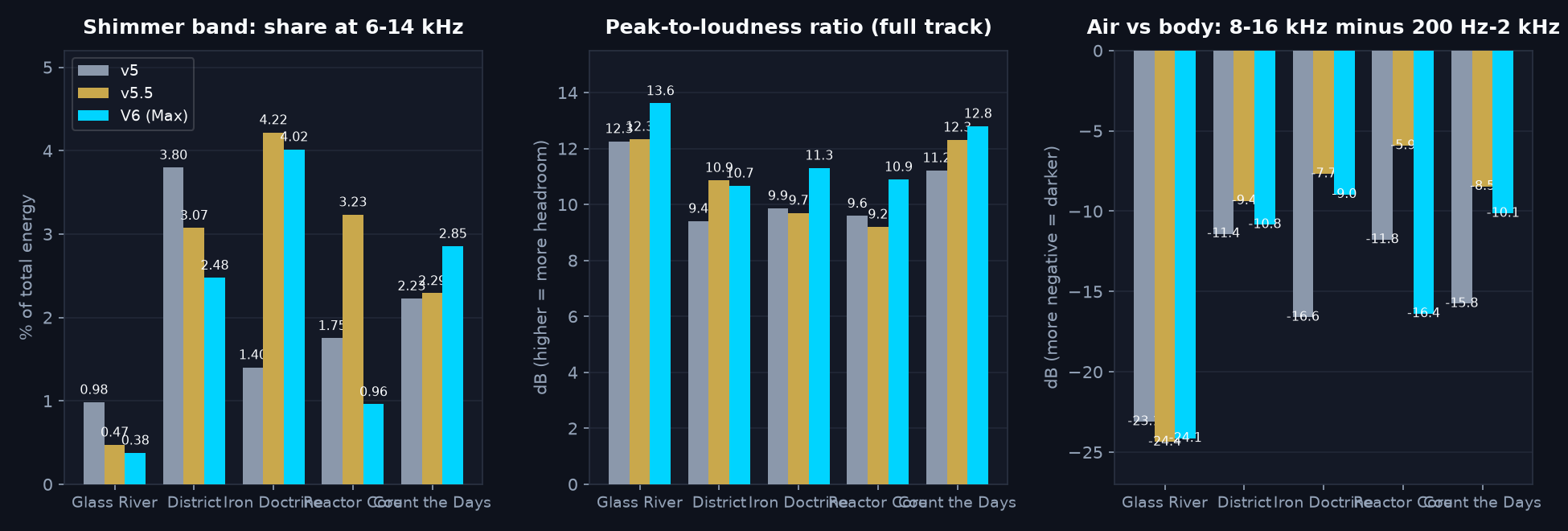
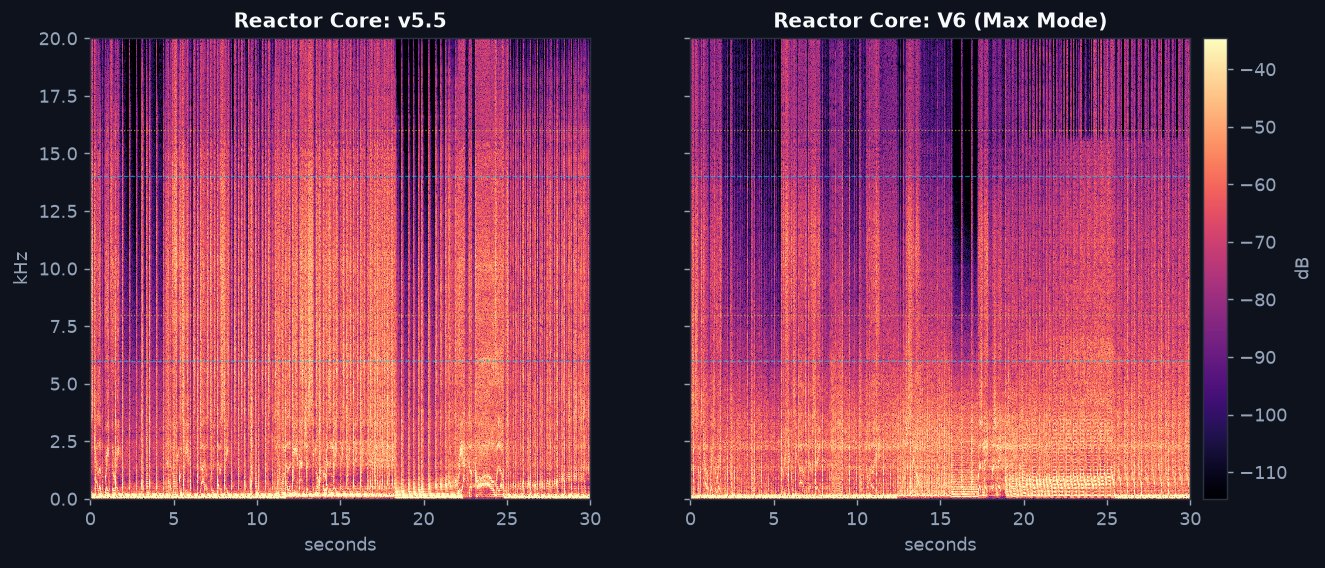
We measured the share of total energy sitting between 8 and 16 kHz, the region people mean when they say air or sheen. It fell on District (down 13 percent) and dropped hard on Reactor Core (down 72 percent). It was flat on Glass River and it went up on Iron Doctrine (up 8 percent) and Count the Days (up 14 percent). Measured as a tilt, air against the body of the mix between 200 Hz and 2 kHz, V6 is darker on four of five, but by a modest 1.3 to 1.7 dB. Reactor Core is the exception at 10.5 dB darker, and it is the track that sounds exactly like the Reddit complaint.
The very top of the spectrum tells a different story. Energy between 14 and 20 kHz went up on three of five, and on Count the Days it is ten times what v5.5 delivered. Whatever V6 is doing, it is not low-pass filtering the output.
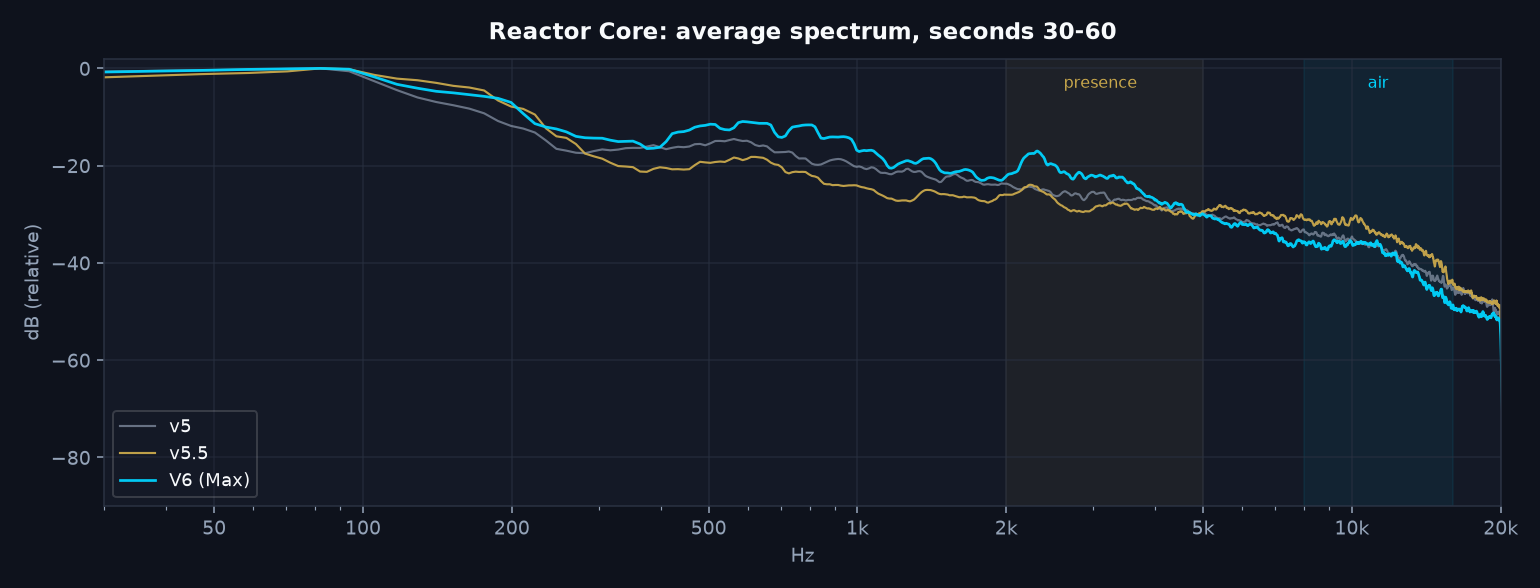
The Reactor Core spectrum explains the complaint better than any adjective. V6 did not remove the top end. It raised the low mids and the presence region by 5 to 8 dB and let the air fall away above 10 kHz. Relative to that thicker middle, the top sounds covered. On a track that was already dense, that is a blanket. On a sparse ballad it is nothing at all.
Vocals buried? The opposite
The presence band from 2 to 5 kHz is where a vocal cuts through a mix. Its share of total energy went up on four of five tracks: District up 29 percent, Iron Doctrine up 51 percent, Reactor Core up 153 percent, Count the Days up 17 percent. Only Glass River, a piano and a single voice, lost presence energy, down 44 percent, and on that track the voice is the only thing there so it hardly needs to fight.
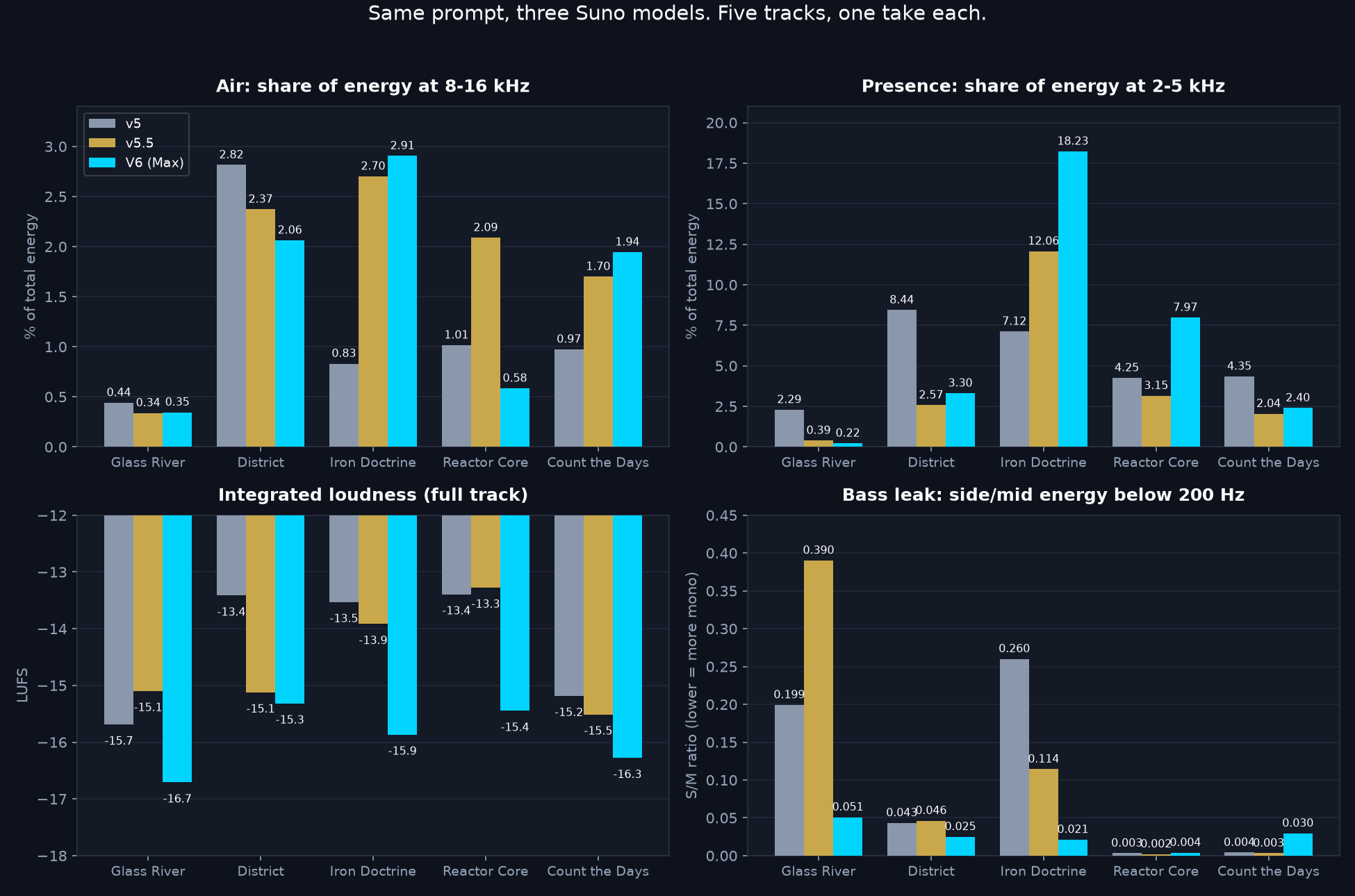
Put the two findings together and both camps are describing the same data. Energy moved out of the sheen and into the presence band. If you listen for the vocal, V6 is clearer and more forward. If you listen for the sparkle on top, there is less of it, and next to a hotter midrange it feels covered. Neither camp is wrong about what it hears. They are hearing different halves of one rebalance.
There is one more thing, and we will not pretend a meter caught it. V6 has a different tonal character. Not brighter, not darker in a way a tilt captures, but a different voice, closer in some ways to the v4 era than to v5.5, though not on that scale. The engine underneath clearly changed a great deal, and a good ear picks it up in seconds. That is, we suspect, what a lot of the emotional reaction is really about: not a defect, but a sound people had learned to work with is gone, and it is not coming back.
What actually got cleaner
The shimmer band, 6 to 14 kHz, where neural audio tends to carry its glassy haze, lost share on four of five tracks: Glass River down 20 percent, District down 19 percent, Iron Doctrine down 5 percent, Reactor Core down 70 percent. Count the Days went the other way, up 25 percent. As we said in March, this metric cannot tell artifact haze from legitimate bright content, so read it as a trend, not a verdict.
The clearest single improvement in the whole dataset is bass leak, the amount of low-frequency energy below 200 Hz that sits in the stereo sides instead of the centre. Side bass is the classic neural-codec defect, it makes a mix wobble on headphones and collapse on a club system. On the three tracks that had it, it collapsed: Glass River from 0.39 to 0.05, District from 0.046 to 0.025, Iron Doctrine from 0.114 to 0.021. V6 keeps the low end in the middle where it belongs. The two electronic tracks were already near zero and stayed there.
Pro Analysis agrees with the spectrum on the stereo image. Its stereo-stability reading improved on the three non-electronic tracks, and its measure of left-right phase drift dropped on the two guitar tracks, District and Iron Doctrine. It also caught something the energy numbers miss: its high-frequency flutter reading rose slightly on four of five. Less top-end energy, in other words, but what remains flickers a touch more. That matters later, when you reach for an EQ boost.
And here is the number that keeps this whole article honest. Pro Analysis scores each track for overall neural-audio health. From v5.5 to V6 those scores barely moved: 70 to 72, 83 to 83, 86 to 89, 79 to 79, and 70 to 65. V6 is not an artifact leap. It is a balance change. The defects that were there are mostly still there, smaller in some places, larger in others.
Quieter, not louder
The word flatter keeps appearing in the complaints, and flatter usually means squashed: more limiting, less dynamics, everything pinned at the ceiling. The data says the opposite. Integrated loudness went down on all five tracks: Glass River by 1.6 LU, District by 0.2, Iron Doctrine by 2.0, Reactor Core by 2.2, Count the Days by 0.8. True peaks are lower on all five. The peak-to-loudness ratio, a decent proxy for how much headroom a track leaves you, went up on four of five. The crest factor of the 30-second window went up on four of five.
So V6 is not fighting a loudness war. It hands you a quieter file with more room in it. That is good news for mastering and it has one immediate consequence for anyone comparing the models by ear: an unmatched A/B favours v5.5 by up to 2 LU, and louder nearly always sounds better in a quick switch. Every player on this page is loudness matched, with v5.5 brought to the V6 level, so you can hear the balance rather than the volume.
Does it hold together to the end?
Several reports describe V6 losing quality late in a long generation. We split every full track into thirds and compared the last third to the first on tonal balance, spectral centre and loudness. Every model, on every track, gets a little brighter towards the end, which is arrangement: choruses and outros are brighter than intros. The question is how much. On four of five tracks the drift on V6 is smaller than on v5.5.
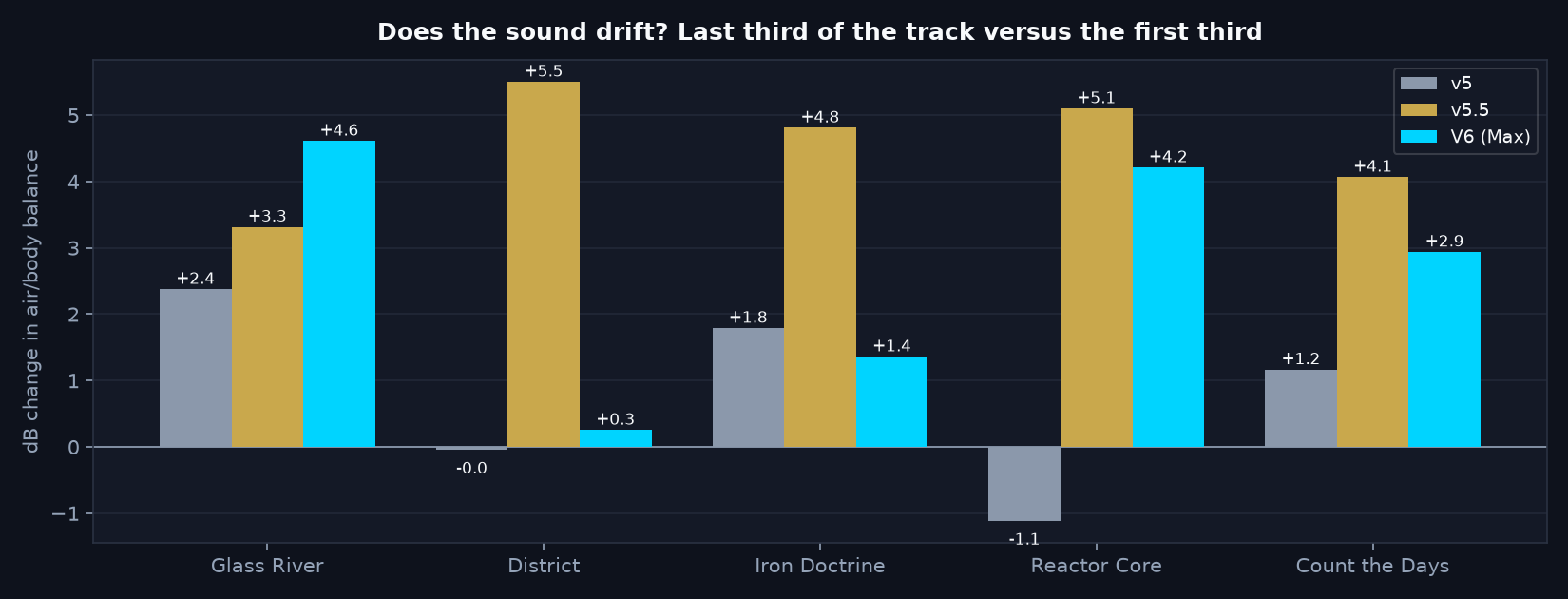
Remember the caveat: these are Max Mode takes. Our own experience without Max Mode was drift after roughly a minute, and Suno's own description of Max Mode is about keeping vocals and style consistent through the whole track. Read together, that suggests Max Mode is not a quality switch at all but a stability switch, and that the late-song complaints may be coming from standard-mode generations. We will measure that properly next time.
Genre by genre, with the audio
Each player below switches between v5.5 and V6, loudness matched. Most clips are the same 20-second window, seconds 30 to 50. Two are offset so the same section of the song lines up: the V6 take of Iron Doctrine has a longer intro and brings the vocal in later, and District lands on the chorus 10 seconds later on v5.5 than on V6. The window is noted under each player. Headphones help.
Reactor Core: the Reddit track
This is the one that fits the complaint. Air energy down 72 percent, tilt 10.5 dB darker, the low mids and presence region 5 to 8 dB hotter. It is also the track that got cleanest by our shimmer measure, down 70 percent, and it came in 2.2 LU quieter with 1.7 dB more peak-to-loudness headroom. If you make this kind of music, you will hear V6 as a blanket. You will also hear a spoken vocal that sits in front instead of behind the kick, presence share up 153 percent, and a mix that is not being hammered into the limiter.
Iron Doctrine: metal, the honest tension
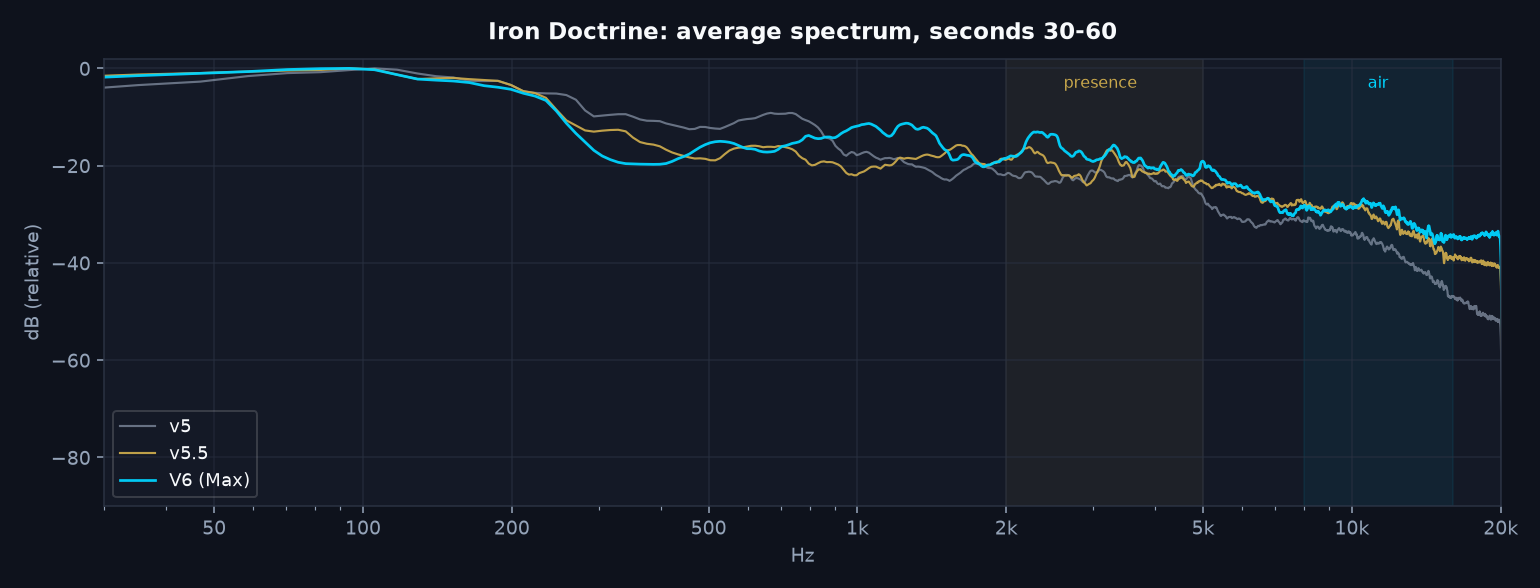
To our ears this is the weakest of the five V6 tracks, and the community agrees about metal. The numbers back that up in a specific way. Iron Doctrine has the highest shimmer share of the five V6 tracks, the lowest dynamic range at 5.7 dB, the flattest short-term loudness (2.0 dB of variation across the whole song, a third less than v5.5), and the presence band is up 51 percent, which on distorted guitars reads as harsh rather than clear. It also improved the least: shimmer down only 5 percent.
And yet Pro Analysis gives it the highest health score of the five, 89, up from 86. Those two facts are not in conflict. The score measures neural-audio defects, and V6 metal has few of them: bass leak down from 0.114 to 0.021, phase drift down by a third. What it has instead is a dense, harsh, undynamic mix, which is a musical problem, not an artifact problem. A defect detector cannot hear that a wall of guitars is fatiguing. You can.
Glass River: where V6 is simply better
In March this was the cleanest improvement from v5 to v5.5, and V6 continues the line. Shimmer down another 20 percent. Bass leak, which v5.5 had made worse, from 0.39 down to 0.05, so the piano's low end finally sits in the centre. Dynamic range in the window jumped from 15.8 to 26.5 dB, and the whole track is 1.6 LU quieter. The presence share halved, but with one voice over one piano there is nothing to cut through. On the tonal side this is the track where V6's changed character is most audible: the piano and the voice are the same instruments, and they are not the same sound.
District: the smallest change
If you only listened to this one you might wonder what the fuss is about. Loudness within 0.2 LU of v5.5, air down 13 percent, presence up 29 percent, shimmer down 19 percent, bass leak halved, stereo image a little narrower and steadier. Every change is in the direction of the overall pattern and every change is small. Pro Analysis scored both versions 83.
Count the Days: less 808, more top
This is the outlier on the shimmer measure, up 25 percent, and the one track where the extreme top gained real energy, ten times the 14 to 20 kHz content of v5.5. It is also the track where V6 pulled back the sub: energy below 80 Hz fell from 70 to 45 percent of the total, and Pro Analysis's sub-bass dominance reading fell with it, as did its pumping reading, from 65 to 30. In March the v5.5 take was the one that surprised us by turning Memphis-sparse; V6 keeps the space but fills in the top. Whether that is better depends on how much 808 you wanted.
What this means for your mastering chain
- Expect a quieter file with more headroom. V6 arrives 1 to 2 LU below v5.5 with a higher peak-to-loudness ratio. Your limiter has room to work, and you need less corrective processing before the loudness stage.
- The bass is already nearly mono. On v5 and v5.5 the first move on a ballad or a rock track was often to collapse the low end to the centre. On V6 that is mostly done for you. Check it, but expect to leave it alone.
- The sheen is where you will be tempted to reach. Air is down on four of five. A gentle shelf from 10 to 12 kHz brings it back, but go carefully: the high-frequency flutter reading went up slightly on the same tracks, and a shelf lifts the flicker along with the sparkle. Small moves, and listen on headphones.
- Presence is hotter, and on dense genres it bites. Metal and techno vocals came in with 50 to 150 percent more energy between 2 and 5 kHz. A modest cut around 3 to 4 kHz, or a de-esser doing the same job dynamically, keeps them forward without the fatigue. Do it before the limiter, not after.
- The tonal character is not an EQ problem. If a V6 track sounds like a different singer or a different piano, that is the model, not the mix. No amount of mastering turns it back into v5.5.
Honest conclusion
Five prompts, three models, one take each, one measurement pipeline. Within those limits, and they are real limits, V6 with Max Mode is quieter, keeps its bass in the centre, pushes vocals forward, carries a little less sheen above 8 kHz, and drifts less from the start of a song to the end. On a defect scorecard it lands almost exactly where v5.5 did. On a musical scorecard, and this is opinion, not measurement, the V6 versions of these five songs are the first ones we would actually put on. The v5 and v5.5 takes were test material. Some of the V6 takes are songs.
Metal is the weak spot and the numbers say why: dense, flat, harsh in the presence band, and the least improved. The muffled complaint is real on the track that fits it and absent on the tracks that do not, which is the same genre-dependent behaviour we found between v5 and v5.5. And the change in tonal character that has people cancelling subscriptions is real too. It just is not on any meter.
What we could not test: Max Mode against standard mode, v6-wild, and v6-mini. Those are the next ten downloads, and the next article.
See what V6 did to your track
Step 1. Drop any V6 export into the MasterForge Audio Analyzer for a free health score and artifact breakdown. No account needed.
Step 2. Run it through Pro Analysis for the full diagnostic used in this article, with a correction plan for what it finds, then finish it in Pro Master. Everything runs in the browser and your audio never leaves your device.
If you would rather not touch a single control, our hand-finished mastering service takes your track and returns a release-ready master, finished by a person, not a preset.
Appendix: complete metrics
Spectral metrics from seconds 30 to 60 of each track, middle 60 percent analysed. Loudness, true peak and peak-to-loudness ratio from the full track. All values from one pipeline applied identically to all three models. Absolute values differ from the March article, which used an earlier implementation; directions agree.
| Track | Model | Shimmer 6-14k % | Air 8-16k % | Top 14-20k % | Presence 2-5k % | Sub 20-80 % | Bass leak S/M | Width | Crest dB | DR dB | LUFS-I | True peak | PLR dB | Length |
|---|---|---|---|---|---|---|---|---|---|---|---|---|---|---|
| Glass River | v5 | 0.98 | 0.44 | 0.008 | 2.29 | 0.1 | 0.199 | 0.154 | 13.3 | 15.7 | -15.7 | -3.43 | 12.3 | 2:17 |
| v5.5 | 0.47 | 0.34 | 0.021 | 0.39 | 0.4 | 0.390 | 0.121 | 14.0 | 15.8 | -15.1 | -2.76 | 12.3 | 2:34 | |
| V6 | 0.38 | 0.35 | 0.016 | 0.22 | 0.6 | 0.051 | 0.068 | 15.6 | 26.5 | -16.7 | -3.10 | 13.6 | 2:42 | |
| District | v5 | 3.80 | 2.82 | 0.214 | 8.44 | 14.7 | 0.043 | 0.110 | 11.4 | 5.7 | -13.4 | -4.01 | 9.4 | 2:27 |
| v5.5 | 3.07 | 2.37 | 0.117 | 2.57 | 19.3 | 0.046 | 0.179 | 13.1 | 8.5 | -15.1 | -4.25 | 10.9 | 2:37 | |
| V6 | 2.48 | 2.06 | 0.241 | 3.30 | 22.8 | 0.025 | 0.149 | 11.9 | 9.9 | -15.3 | -4.65 | 10.7 | 2:26 | |
| Iron Doctrine | v5 | 1.40 | 0.83 | 0.052 | 7.12 | 15.0 | 0.260 | 0.465 | 11.2 | 5.4 | -13.5 | -3.66 | 9.9 | 4:14 |
| v5.5 | 4.22 | 2.70 | 0.352 | 12.06 | 29.6 | 0.114 | 0.233 | 11.9 | 6.2 | -13.9 | -4.22 | 9.7 | 3:39 | |
| V6 | 4.02 | 2.91 | 0.788 | 18.23 | 22.8 | 0.021 | 0.122 | 14.6 | 5.7 | -15.9 | -4.56 | 11.3 | 3:51 | |
| Reactor Core | v5 | 1.75 | 1.01 | 0.112 | 4.25 | 58.7 | 0.003 | 0.026 | 10.4 | 9.7 | -13.4 | -3.80 | 9.6 | 3:10 |
| v5.5 | 3.23 | 2.09 | 0.186 | 3.15 | 42.5 | 0.002 | 0.020 | 10.7 | 11.1 | -13.3 | -4.07 | 9.2 | 3:23 | |
| V6 | 0.96 | 0.58 | 0.043 | 7.97 | 43.1 | 0.004 | 0.033 | 12.0 | 9.4 | -15.4 | -4.55 | 10.9 | 3:22 | |
| Count the Days | v5 | 2.23 | 0.97 | 0.042 | 4.35 | 46.4 | 0.004 | 0.077 | 11.7 | 13.1 | -15.2 | -3.97 | 11.2 | 1:42 |
| v5.5 | 2.29 | 1.70 | 0.029 | 2.04 | 69.7 | 0.003 | 0.008 | 12.3 | 26.5 | -15.5 | -3.20 | 12.3 | 1:32 | |
| V6 | 2.85 | 1.94 | 0.291 | 2.40 | 44.7 | 0.030 | 0.061 | 13.4 | 20.9 | -16.3 | -3.47 | 12.8 | 1:31 |
Shimmer, air, top, presence and sub are shares of total energy between 20 Hz and 20 kHz. Bass leak is side energy divided by mid energy below 200 Hz. Width is one minus the left-right correlation. DR is the spread between the 95th and 5th percentile of 50 ms RMS frames. LUFS-I and true peak per ITU-R BS.1770-4 with 4x oversampling.