13 Tracks, 13 Recipes:
What Mastering Actually Does to AI Music
1. Side cleanup is universal. Every Suno track we tested had artifacts concentrated in the side channel. Cleaning them improved every single one. No exceptions.
2. Everything else depends on the song. Loudness, dynamics, EQ, transient shaping, codec ceiling treatment: the right move changed on every track. A sparse ballad and a five-piece metal band need opposite treatments. Generic presets can't know that.
3. Black-box mastering leaves quality on the table. Most online mastering services apply a single algorithm to every upload. They don't decompose mid and side. They don't measure phase risk. They don't adapt per genre. That works for loudness. It doesn't work for AI music, where the artifacts live in places those tools never look.
Why We Measured Everything
We mastered 13 Suno tracks and measured every one of them before and after. Loudness, peak, true peak, crest factor, PSR, LRA, brick-wall ceiling, mid/side ratios in six frequency bands, L/R correlation over time, and phase risk. Every number in this article comes from real analysis, not theory.
The result is what you'd expect from any honest data set: messy, varied, and full of patterns once you know where to look.
The most important pattern is that each track needed something different. That's the core problem with one-click mastering: it treats every upload the same way, because it has to. It doesn't know whether your track is a sparse piano ballad or a dense metal wall. It doesn't know that your side channel is full of codec residue at 1 kHz, or that your bass is bleeding into the stereo field. It makes the track louder and calls it done.
This article shows what happens when mastering actually looks at the song first.
13 Tracks. 13 Different Masters.
The test set: sparse ballads, pop, rock, cinematic, reggae, witch house, automotive sub-bass demos, and four metal tracks. Both Suno v5 and v5.5. A wide range of genres, BPMs, durations, and densities.
There's one pattern that stood out immediately. One thing worked on every single track. Not most. All thirteen. Same direction, same mechanism, same result. This is the fix that black-box mastering services could do but don't, because they never decompose the stereo field.
Everything else in this article comes from the things mastering had to do differently per track. But before we get to those, let's start with the universal fix.
The Universal Fix: Stereo Cleanup
If you take only one thing from this article, take this:
Suno's audio puts a lot of garbage in the side channel. Mastering's job, the one job that worked on every track we tested, is to clean it.
To explain what that means, we need to talk briefly about how stereo audio is structured. Any stereo signal can be split into a mid component (the part that's the same in both channels) and a side component (the part that's different). Vocals, kick drum, and bass usually live in the mid. Guitars, ambience, and reverb usually live in the side. This is called M/S decomposition, and it's how mastering engineers think about width and clarity.
When Suno generates audio, the L and R channels are decoded somewhat independently. Anything the codec can't reconstruct identically in both channels ends up in the side. That includes shimmer, fog, codec hash near the top of the spectrum, and bass that should have been mono but isn't. The side becomes a place where artifacts accumulate.
The chart below shows how much side cleanup each master had to do in the most artifact-heavy band, between 500 Hz and 2 kHz.
Universal direction, varied magnitude. The cleanup goes the same way on every track. Sparser sources need less. Denser sources need more.
The artifacts you hear as “AI-ness” in a Suno track are largely concentrated in the side channel below 2 kHz. Cleaning the side, especially in the mids around 1 kHz, is what turns an “obviously AI” track into one that can pass on a phone speaker without raising eyebrows.
The dramatic example is Endless Darkness, the metal track we used to stress-test phase risk. On the raw Suno output, the L and R channels were further out of phase than in phase for 54.8% of the song. Correlation averaged 0.44, which is alarmingly low.
After mastering, correlation rose to 0.92. Phase risk dropped to 0.2%. The biggest single move across all 13 tracks.
Listen to it yourself.
Each player loads its Raw and Mastered MP3 files into memory before playback. First load on a track takes a couple of seconds; after that, switching between Raw and Mastered is instant and seamless. The Stop button next to Play resets a track to the beginning. Starting playback on one track automatically pauses the others.
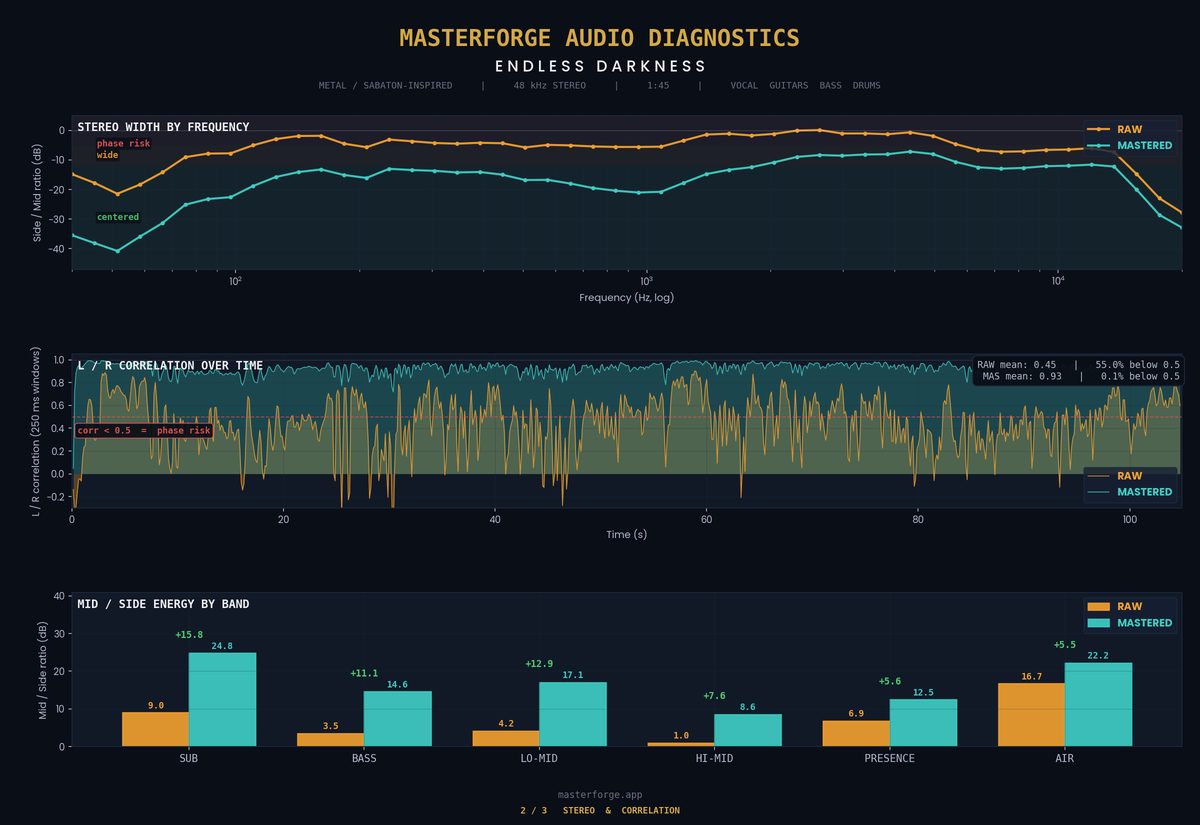
The raw version sounds harsh, congested, and oddly hollow. The mastered version is the same song, same arrangement, same vocal performance. But the metallic chaos in the upper midrange has settled, the kick is centered, and the guitars sit in front instead of smearing across the field.
Nothing was added. Side residue was removed.
This pattern repeats with different intensities on every track in the set. Pop tracks have it concentrated in the mids (500 Hz to 2 kHz). Metal tracks have it across the whole spectrum. Sparse acoustic tracks have it mostly in the bass. The exact treatment depends on the song. But the direction, side cleanup, never reverses.
MasterForge Starter handles side cleanup automatically as part of every preset. It's effective for most material. Pro Master gives you a six-band M/S EQ (Mid Lo, Mid Mid, Mid Hi, Side Lo, Side Mid, Side Hi), each band independently adjustable, with real-time monitoring. You can hear the side artifacts disappear as you cut. For the metal and dense electronic tracks in this set, the manual control made a noticeable difference.
Thirteen Tracks, Thirteen Recipes
Here's the full set, ordered by lesson rather than by genre. The cards move from sparse arrangements (where mastering does the most surgical work) to dense arrangements (where mastering does the most aggressive work, and where the limits start to show).
Each card includes what Suno produced, what mastering did, and which MasterForge presets and Pro Master controls fit the case. Numbers come straight from the analysis. The audio player on each card lets you toggle between the raw Suno output and the mastered version in sync.
1. Slow Bloom
What Suno produced
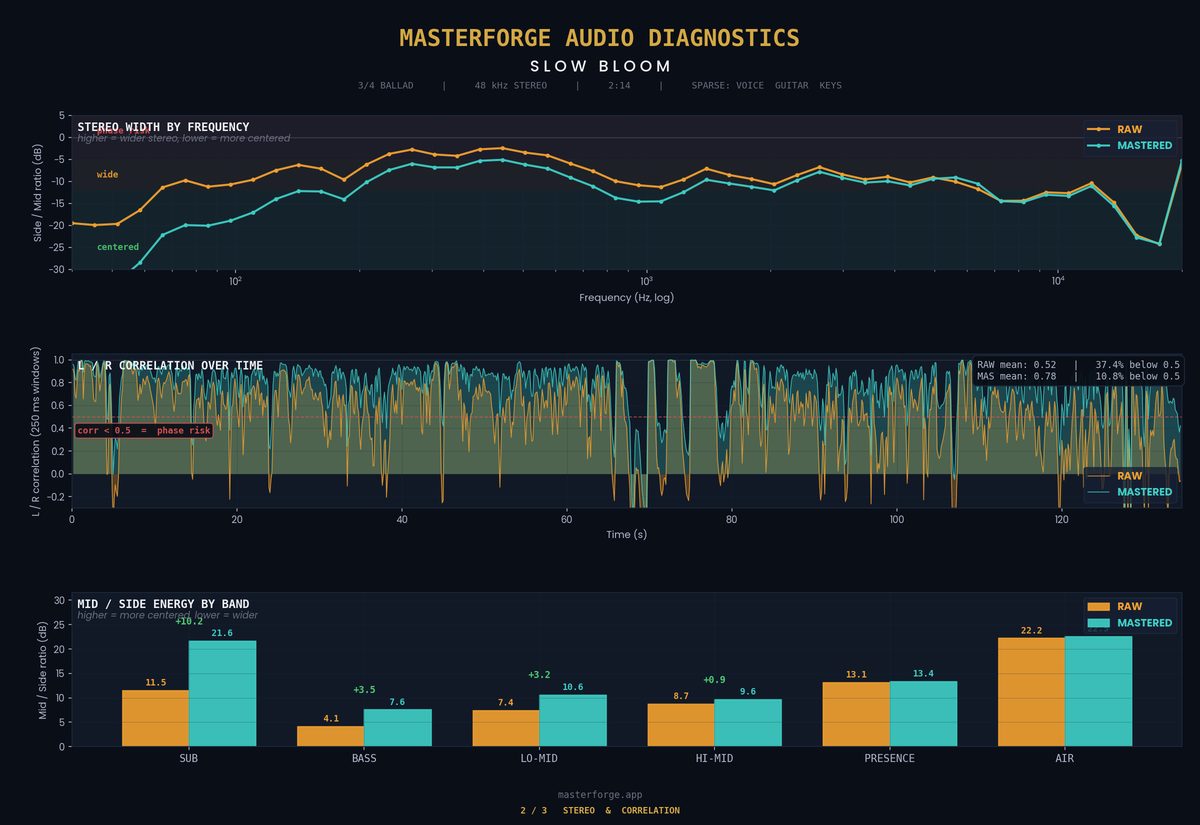
A quiet 3/4 ballad with natural space. Codec ceiling at 11.2 kHz, which preserves the warmth of a sparse arrangement. The side channel was wide in the sub band (M/S +11.5 dB), and L/R correlation dropped below 0.5 about 42% of the time. Phase risk in a sparse mix is unusual, and it tells you the bass was bleeding into the stereo field.
What mastering did
Peak rose +2.6 dB while dynamics opened up at the same time (PSR +2.4 dB). That combination is rare. The track became more present without becoming tighter. The most important change was sub cleanup: an M/S Sub increase of +10.2 dB centered the bass aggressively, correlation rose from 0.49 to 0.76, and phase risk collapsed to 13.5%. No air was added, because the piano carries the top end on its own.
Try this
Open & Natural. Preserves the sparse character and avoids over-compression. Smart Recommendation will land here too if you let it pick.Gentle Master. Bass Mono at 120 Hz. Side EQ Lo (200 Hz) at -2 dB. Real-time monitoring lets you hear the low-end width clean up the moment you move the slider.2. Bright Side
What Suno produced
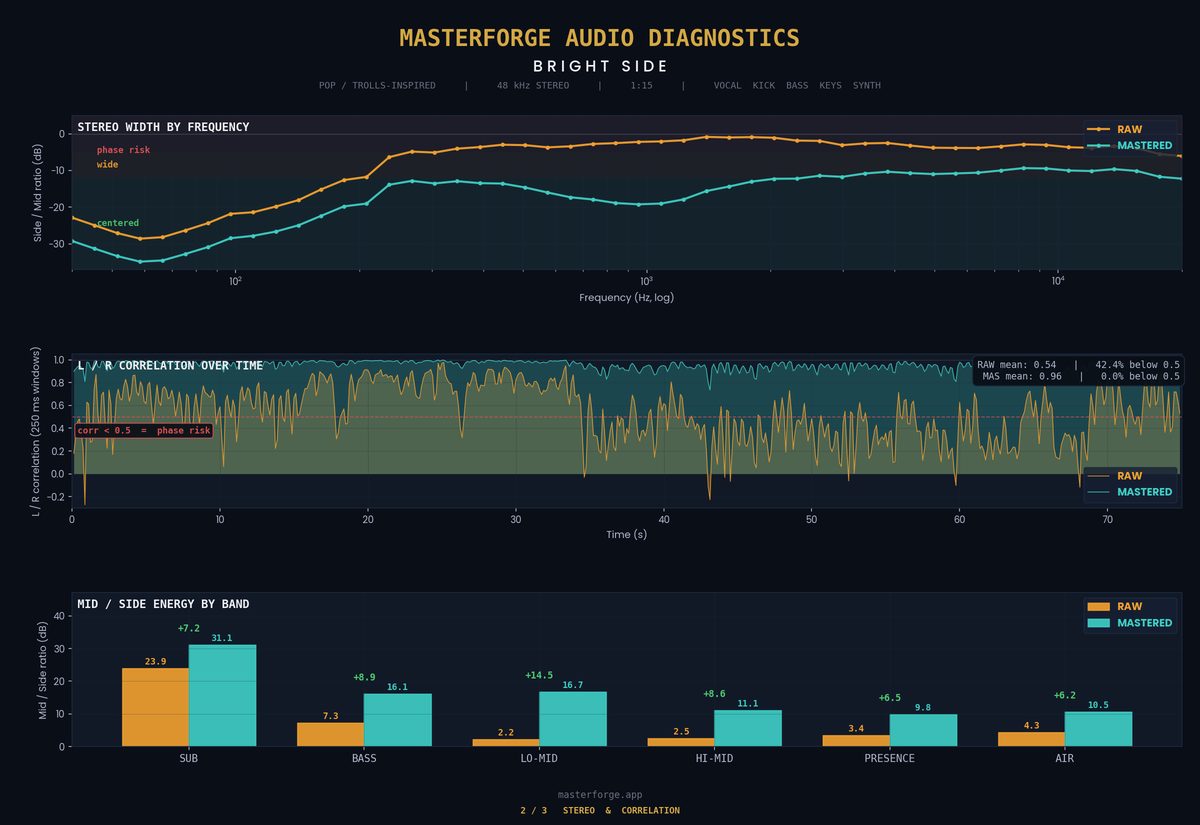
A bright, energetic pop bed with strong bass presence (M/S Sub already at +23.9 dB on the raw). The side was unusually narrow in Lo-Mid (+2.2 dB), which means the midrange artifacts were stuck in the side channel rather than properly spread. Phase risk was 44.8%, one of the highest in the set. This is a v5 generation, and it shows the v5 codec hash near the top of the spectrum.
What mastering did
Peak barely moved (-0.3 dB), but correlation jumped from 0.51 to 0.95 and phase risk dropped to nearly zero. The Lo-Mid M/S delta of +14.5 dB is the largest single-band cleanup in the entire set. That move, side mids pulled down hard, is what carried this master. LRA tightened from 4.1 to 2.8 dB, which gives the track a steadier pop level without sounding compressed. There was also a deliberate cut around 16 kHz to remove the v5 codec hash above the music.
Try this
Bright & Airy. Suits the pop character and adds the right amount of top end without harshness.Pop Modern plus Side EQ Mid (1 kHz) at -3 dB. That single move does most of the work. With real-time monitoring you can hear the midrange “fog” lift off the moment you cut.3. District
What Suno produced
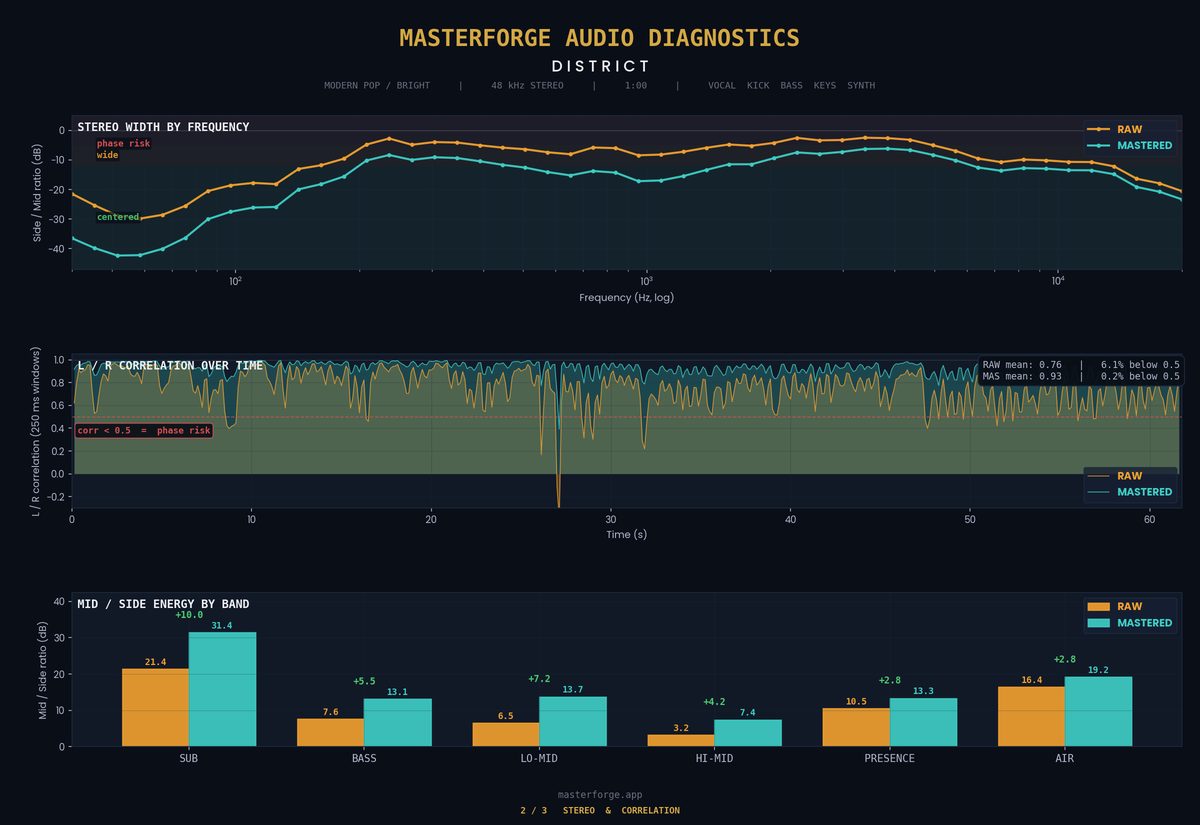
A balanced modern pop arrangement, BW 15.3 kHz. Phase risk was already a manageable 10.6%. The side distribution was reasonable, but Lo-Mid sat at +6.5 dB, which left room for cleanup.
What mastering did
Peak +1.4 dB, Crest +1.5 dB, and LRA +1.0 dB simultaneously. That is a rare result: louder and more open and more dynamic. Correlation went 0.74 to 0.92. Lo-Mid side cleanup was +7.2 dB. Good source material can take this kind of treatment, and District's source was good. The takeaway isn't “always lift everything,” it's “when the source allows it, you don't have to choose between loudness and dynamics.”
Try this
Strong & Punchy. Modern pop holds up to extra punch as long as the source is clean, and District's source is clean.Pop Modern plus Side EQ Mid (1 kHz) at -2 dB and Side EQ Lo (200 Hz) at -1.5 dB. Smaller moves than Bright Side, because the side wasn't as messy to begin with.4. Circus
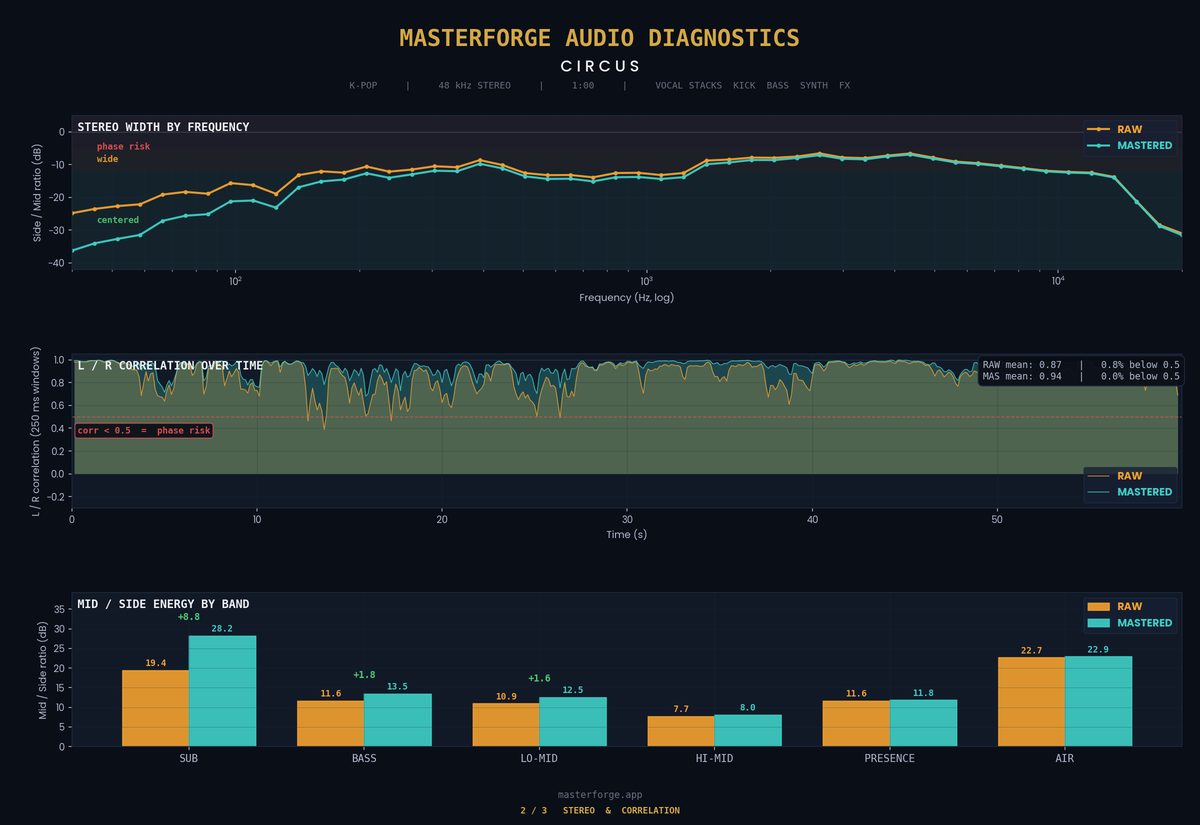
What Suno produced
A polished k-pop production, BW 15.3 kHz. The side distribution was sub-loaded (+19.4 dB) but reasonable elsewhere. Correlation was 0.86 on the raw, near the top of the set. K-pop generations often arrive in this state because the genre's modern aesthetic is closer to what Suno was trained on.
What mastering did
Peak +0.5 dB and Crest -0.6 dB. Almost no intervention. Sub +8.8 dB centered the bass, but every other band moved less than 2 dB. Correlation went 0.86 to 0.93, phase risk 2.6% to 0.2%. This is a finishing master, not a corrective master. If the song already works, your job is to confirm it.
Try this
Balanced. K-pop is usually already balanced, so a strong preset would change the character rather than improve it.Pop Modern near defaults. Bass Mono at 100 Hz. Don't reach for the side EQ. The track doesn't need it, and forcing the move will narrow the production aesthetic that's already working.5. Open All Night
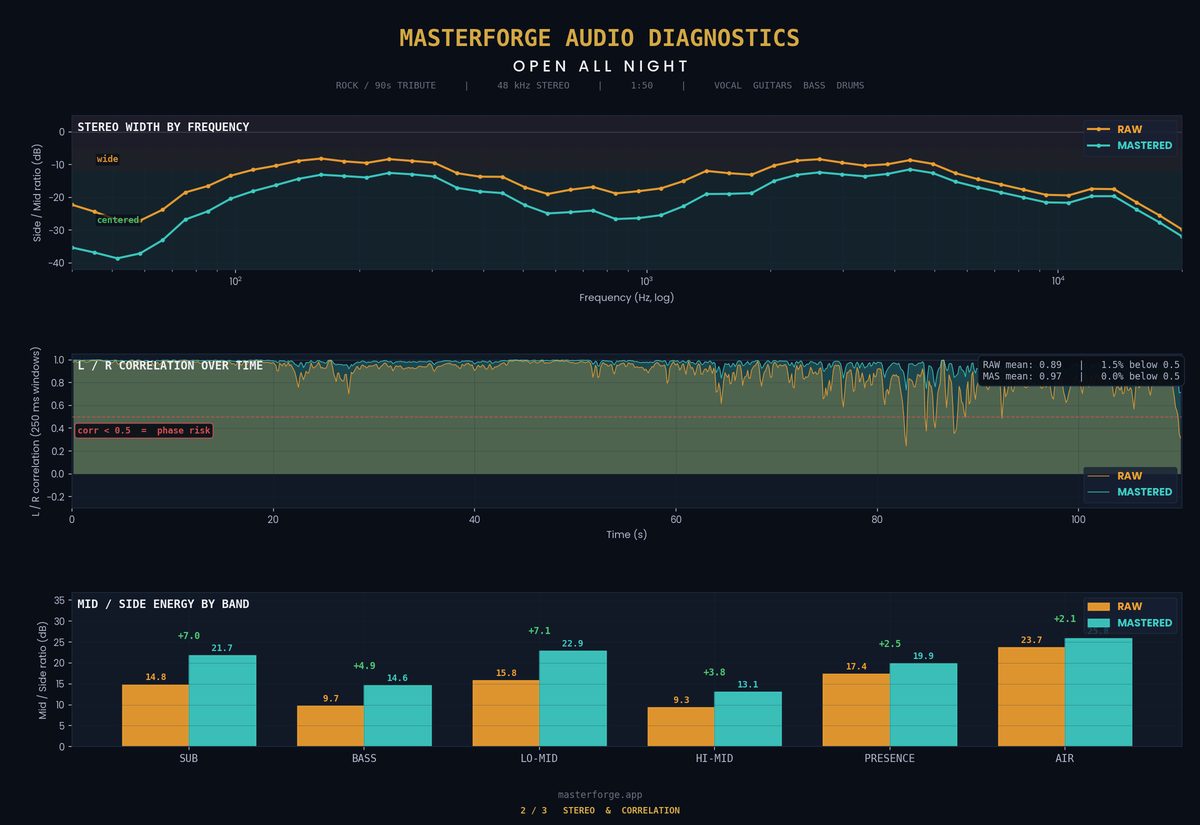
What Suno produced
A tight rock mix at BW 19.8 kHz, the highest in the set, meaning Suno produced this without an aggressive codec ceiling. Side energy was wide on every band (Lo-Mid +15.8 dB, Air +23.7 dB), which is normal for a rock production. Correlation 0.88 on the raw was near professional already.
What mastering did
Peak +0.04 dB. Practically nothing. Crest -0.5 dB and LRA -1.0 dB, mild tightening. Side cleanup stayed moderate across all bands (Sub +7, Bass +5, Lo-Mid +7). The master here didn't fix anything, it confirmed that a good source needs only polish: phase risk dropped from 2.8% to zero, correlation rose to 0.96. The vocals and guitar body got pulled toward center, which is the Foo Fighters polish at work.
Try this
Open & Natural or Balanced. Don't use Strong & Punchy. It will kill the rock dynamics you came for.Rock Punch as a starting point, but pull the compressor ratio back. Side EQ off. The track does not need it.6. Behind the Veil
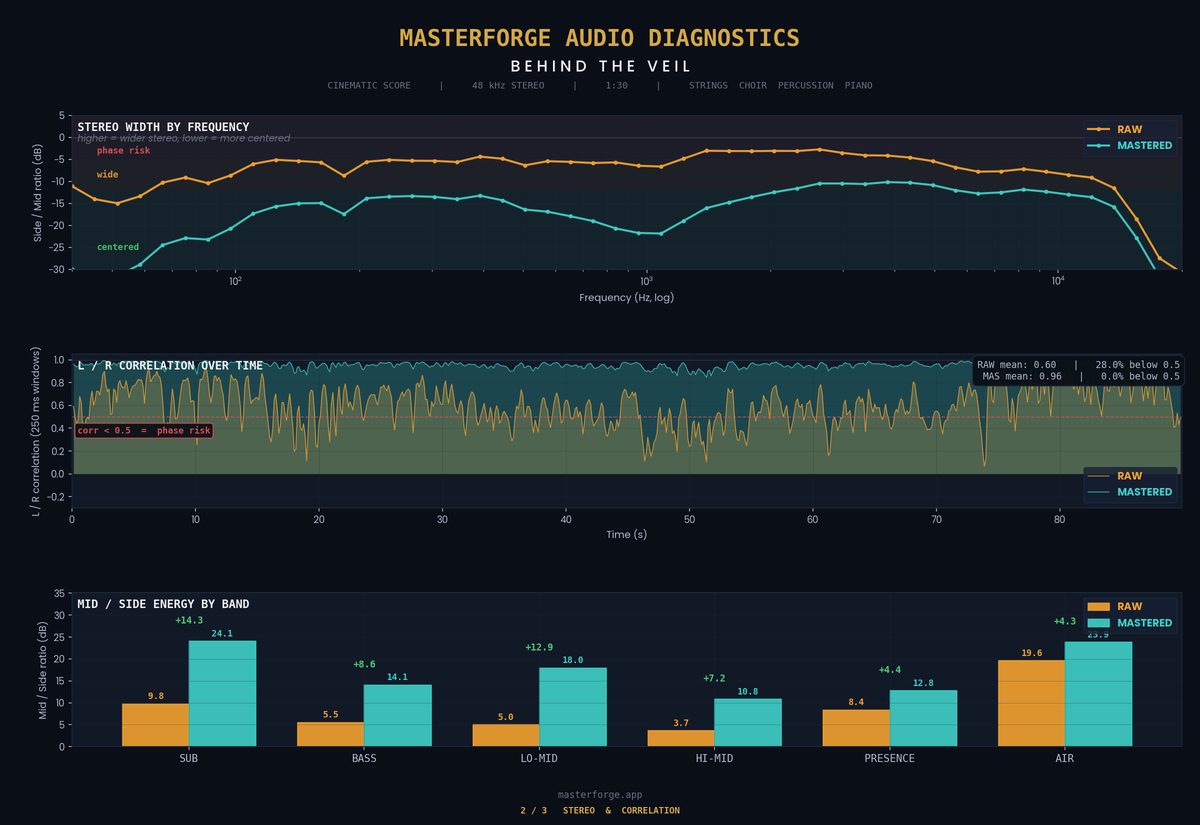
What Suno produced
A wide, atmospheric sound design. BW 16.9 kHz, which is high for a cinematic generation, meaning Suno used the upper spectrum freely. Phase risk 29.8%. The side distribution was more even than in metal generations, but the mids (Lo-Mid +5.0, Hi-Mid +3.7) left room for surgical cleanup.
What mastering did
Peak +0.7 dB and Crest unchanged. Dynamics fully preserved. Correlation jumped from 0.60 to 0.95, phase risk to zero. The Lo-Mid side cleanup of +12.9 dB was the headline number. The paradox: cleaning the side mids made the track feel more spacious, not less. The orchestration came into focus while the room around it stayed intact. This is what surgical mastering looks like.
Try this
Open & Natural. Cinematic material won't survive Bright & Airy or Strong.Gentle Master plus Side EQ Mid (1 kHz) at -3 dB and Bass Mono at 80 Hz. Don't push Width above 100%. The track is already wide where it needs to be.7. Letkuttele
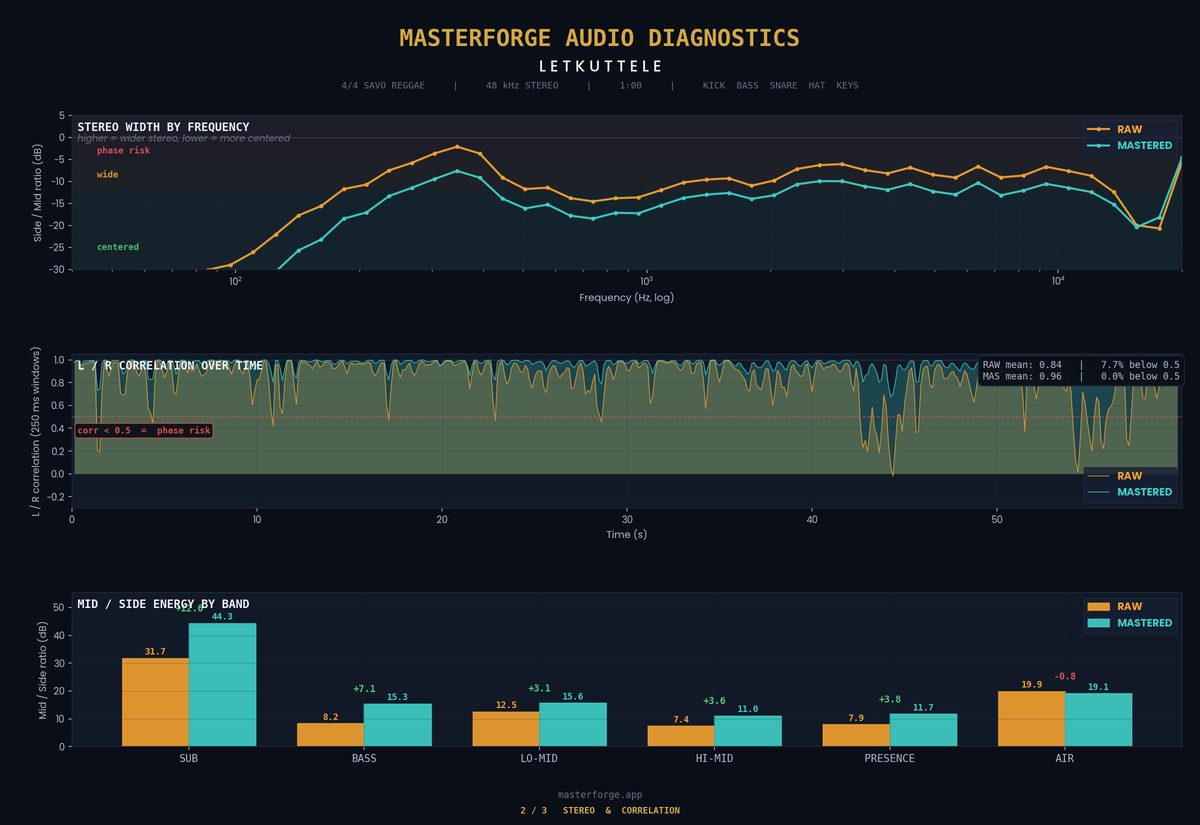
What Suno produced
A reggae bed in tight 4/4, vocals in the Savo dialect. BW 17.2 kHz. The Sub band M/S was already +31.7 dB on the raw, the second highest in the set after Bassure. The hi-hat sizzle (8 to 15 kHz) had a peak-to-peak amplitude of 50.8, which is aggressive for a reggae groove.
What mastering did
Peak -1.3 dB, Crest -1.6 dB, LRA -1.3 dB. Active tightening to find the reggae pocket. Sub +12.6 dB pulled the bass to center. The detail you'd miss in numbers but hear immediately: the hi-hat sizzle peak-to-peak collapsed from 50.8 to 35.7, a 15 dB reduction. The kick rise time also went from 7.5 ms to 10.2 ms, giving the kick a rounder attack that sits inside the reggae feel rather than punching out of it. This is transient protection, not just EQ.
Try this
Warm & Rich. Lets the groove breathe and avoids adding top end.Hip-Hop Crisp as a starting point because the groove DSP is more useful here than the music presets. Transient Shaper Attack -10, Sustain +15. Bass Mono at 100 Hz. De-Esser targeted at the 9 kHz hi-hat region.8. Underwater
What Suno produced
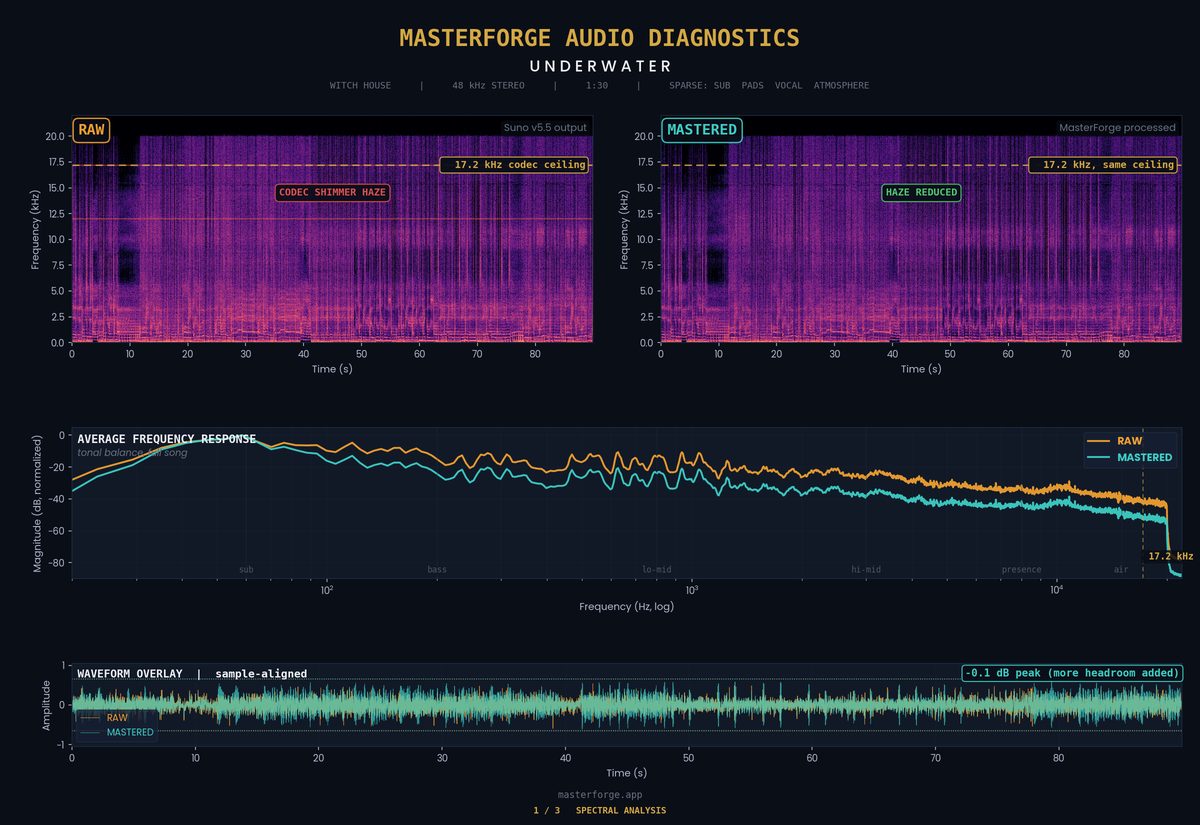
A witch house atmosphere at BW 18.8 kHz, the second highest in the set. The side was reasonable. Sub at +17.8 dB was already strong. Phase risk 8.7% on the raw was a good starting position. The Suno prompt for this track was explicit about lo-fi tape decay and bit crushing as part of the aesthetic, but those textures live in the music itself, not in the codec ceiling.
What mastering did
The headline number is the BW dropping from 18.8 to 10.8 kHz. That's not a side effect, that's the master's choice: codec haze above 11 kHz was identified as residue, not music, and removed. The atmosphere stayed (Lo-Mid +1.9 dB cleanup is small for a reason, the side energy is the witch house feel). Sub side cleanup was +14.3 dB, transients tightened (Crest -3.2 dB), and LRA opened up by +1.2 dB across the song. Correlation went 0.74 to 0.93. The track lost nothing it needed and dropped what it didn't.
Try this
Warm & Rich. Witch house wants warmth, not sparkle.Lo-Fi Chill if it suits, otherwise Gentle Master plus a Linear Phase EQ high-shelf at 11 kHz, -4 dB. This is one of the few masters where deliberately cutting the top end is the right move.9. Bassure
What Suno produced
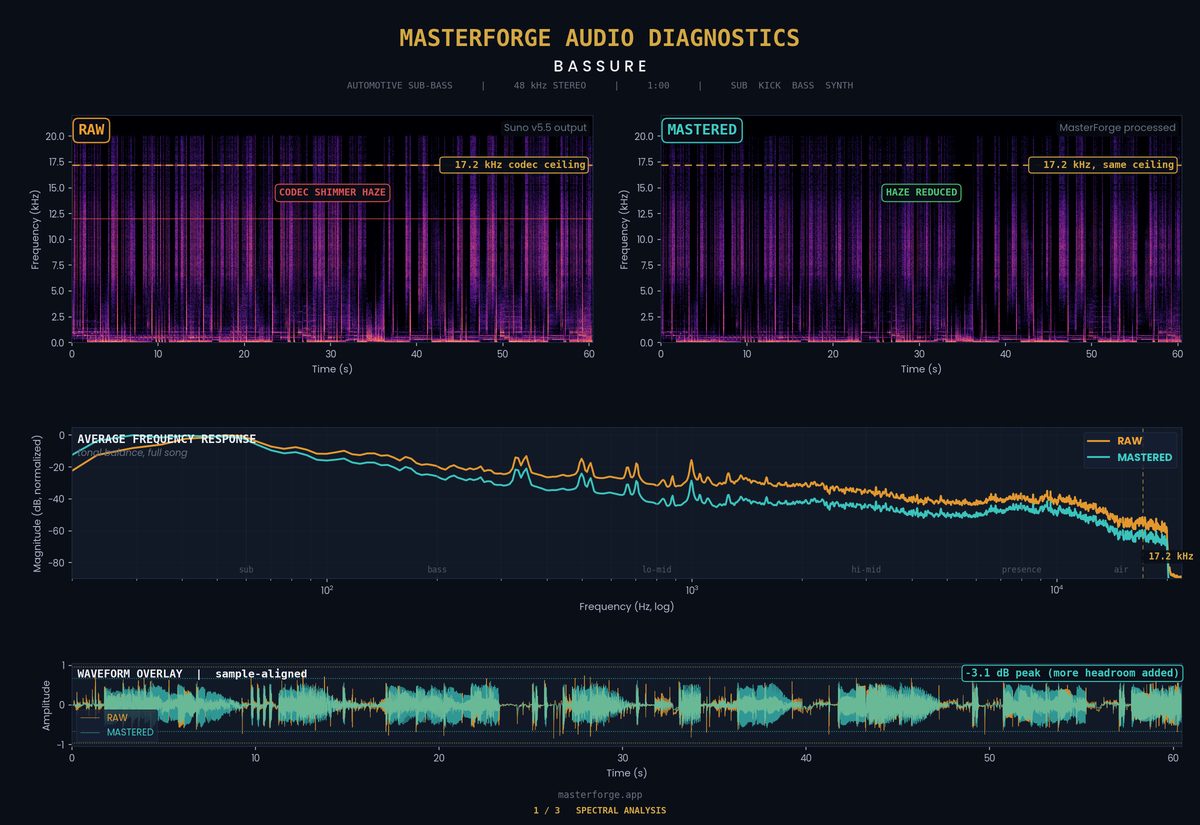
A sub-bass demo at BW 11.2 kHz, Peak -0.36 dB (the highest in the set, nearly clipping). Crest 14.3 dB and PSR 13.7 dB on the raw indicated plenty of headroom for shaping. The Sub band M/S was +38.4 dB, the largest in the set. The Suno prompt was deliberately built for this: “subwoofer demonstration not a song.”
What mastering did
This is real automotive bass mastering, not a normal music master. Peak deliberately lowered by -3.1 dB to leave headroom for the car system's amplifier without forcing it into clipping. Crest tightened by -5.3 dB. BW dropped from 11.2 kHz to 2.2 kHz to remove anything that could compete with the sub. Correlation went 0.92 to 1.00, perfect mono, so the bass doesn't lose energy to phase cancellation in a car cabin. Sub side +18.2 dB centered the bass with the largest single-band move in the set. The result is a track that plays loud in a car without the THD distortion that ruins your dB target or eats into the sub-bass impact.
Try this
Gentle Master, then manual LPF at 2.5 kHz, Sub-Bass Enhancer on, Bass Mono at 200 Hz, Limiter ceiling at -3 dB to leave amplifier headroom. The point isn't loudness on streaming, it's loudness in a car at full volume without distortion taking over.10. Berserk
What Suno produced
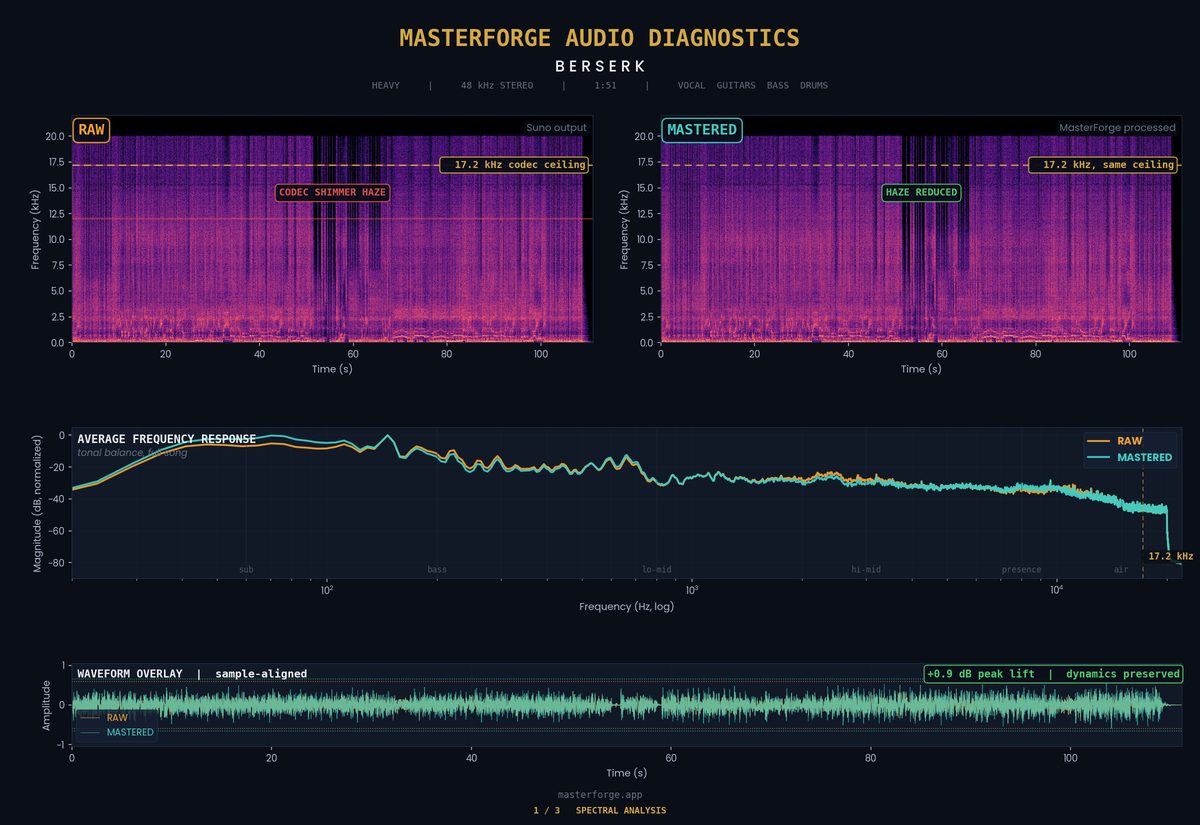
A dense metal bed at BW 14.5 kHz. LRA 2.5 dB on the raw, already tight (genre normal). Phase risk 35%, correlation 0.58. The side was unexpectedly narrow in Lo-Mid (+3.5 dB) and Hi-Mid (+1.7 dB), meaning the “width” was concentrated in the sub and bass bands.
What mastering did
Peak -0.04 dB and Crest -1.3 dB. No reach for loudness. The headline: phase risk collapsed from 35% to 0.5%, correlation 0.58 to 0.95. Side cleanup was among the most aggressive in the set: Sub +15.5 dB, Bass +11.2, Lo-Mid +12.2, Hi-Mid +7.1. The master didn't try to make the track louder. It cleaned the side residue out of a dense metal mix. Codec shimmer is still audible above the music, and that limit is real.
Try this
Metal Wall if you want a one-click answer, but the side cleanup will be incomplete.Metal Wall plus Side EQ Mid (1 kHz) at -4 dB and Side EQ Hi (8 kHz) at -3 dB. AI Artifact Suppressor at 50%, Shimmer threshold 12 dB. Real-time monitoring shows you the shimmer floor, which is exactly where the limit of this approach is. Beyond it, you're in SpectralForge territory.11. Raw Nerve
What Suno produced
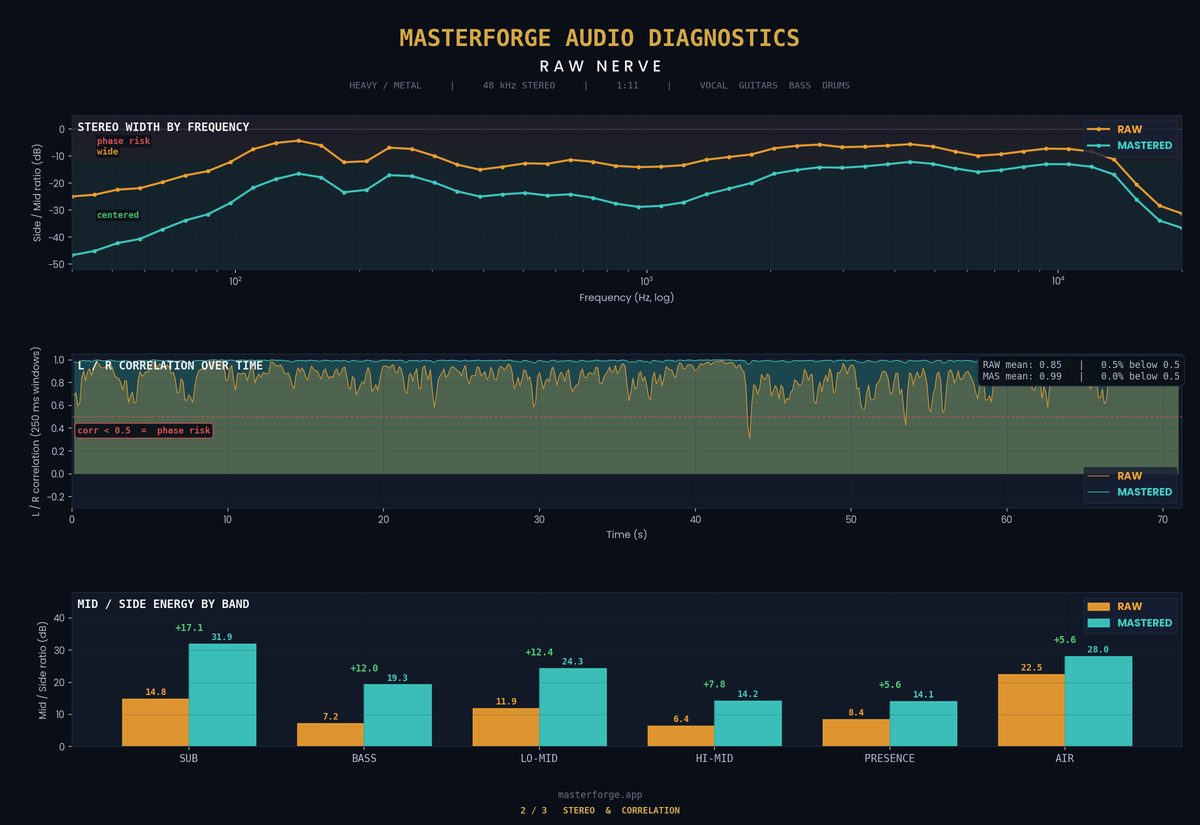
BW 17.8 kHz, second highest in the set. Suno produced this without an aggressive codec ceiling. Correlation 0.84 on the raw was excellent already, phase risk only 1.9%. The side was Lo-Mid +11.9 dB and Air +22.5 dB.
What mastering did
Peak +0.9 dB, Crest +0.8 dB, PSR +1.9 dB. Loudness and dynamics rose at the same time, like District. Correlation 0.84 to 0.99. Side cleanup was the most aggressive in the entire set: Sub +17.1 dB, Lo-Mid +12.4 dB. The master succeeded at both loudness and cleanliness, which is rare on metal material.
Try this
Strong & Punchy can work here (this leans rock-metal), but Metal Wall is the safer default.Metal Wall plus AI Artifact Suppressor at 40%, Shimmer 10 dB, Fog 6 dB. Side EQ Mid (1 kHz) at -3 dB. This is the case where Pro Master earns its money on top of an already-good source: General leaves something on the table, and you can hear it on monitoring.12. Endless Darkness
What Suno produced
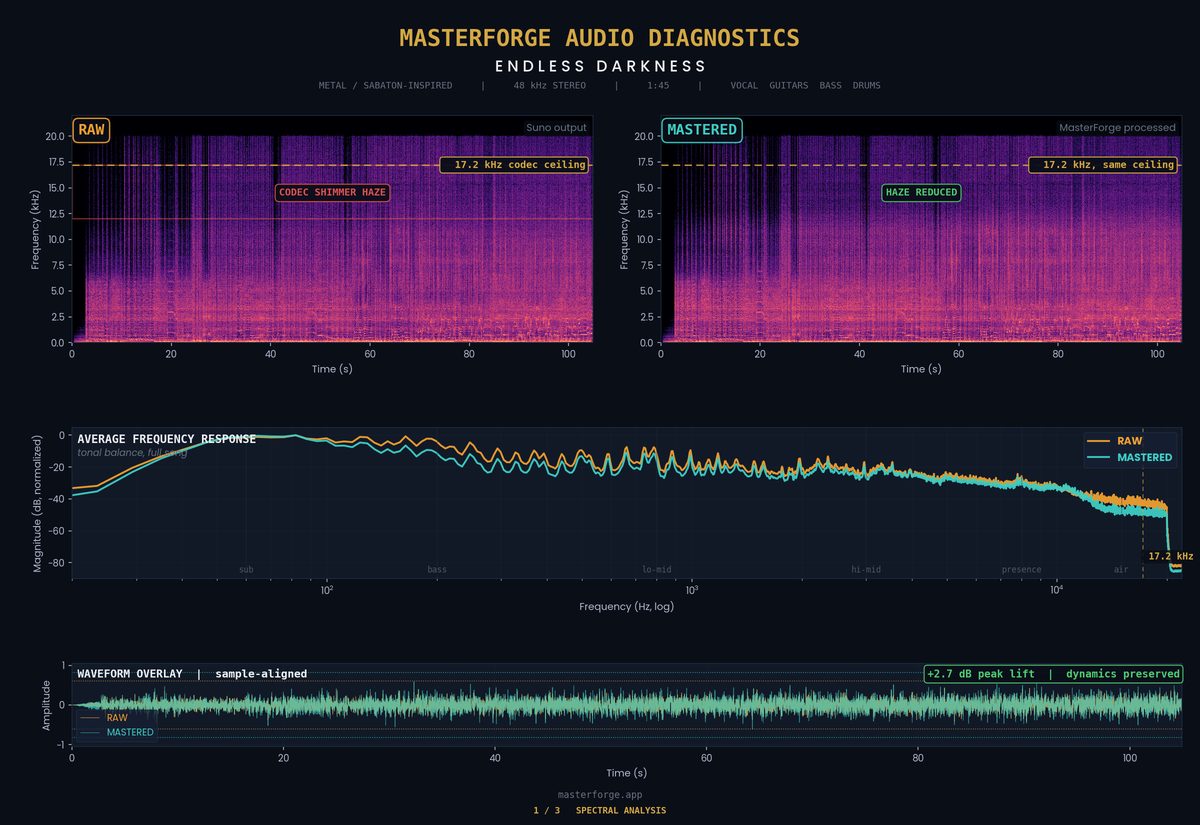
A dense Sabaton-style metal bed, BW 16.6 kHz. Phase risk 54.8% on the raw is the highest in the set. For more than half the song, the channels were further out of phase than in phase. Correlation 0.44 on the raw is alarmingly low. The Hi-Mid side was only +1.0 dB, meaning metal shimmer was distributed unpredictably across mid and side channels rather than sitting cleanly in either.
What mastering did
Peak +2.2 dB, Crest +1.9 dB, PSR +2.2 dB. Loudness, dynamics, and transient quality all improved together. The headline: correlation rose from 0.44 to 0.92, and phase risk collapsed from 54.8% to 0.2%. That's the biggest single move across all 13 tracks, and it tells you that Suno's metal generations can be very messy in phase, but the problem is fixable. Side cleanup: Sub +15.8 dB, Lo-Mid +12.9 dB.
Try this
Metal Wall. Reasonable cleanup, but the phase correction is left to automation.Metal Wall plus manual Side EQ Mid (1 kHz) at -4 dB and Side EQ Hi (8 kHz) at -3 dB. AI Artifact Suppressor at 60%, Shimmer 14 dB, Fog 8 dB. This is Pro Master's clearest demonstration: real-time monitoring shows the phase error vanishing the moment side mids settle.13. Forever Sun
What Suno produced
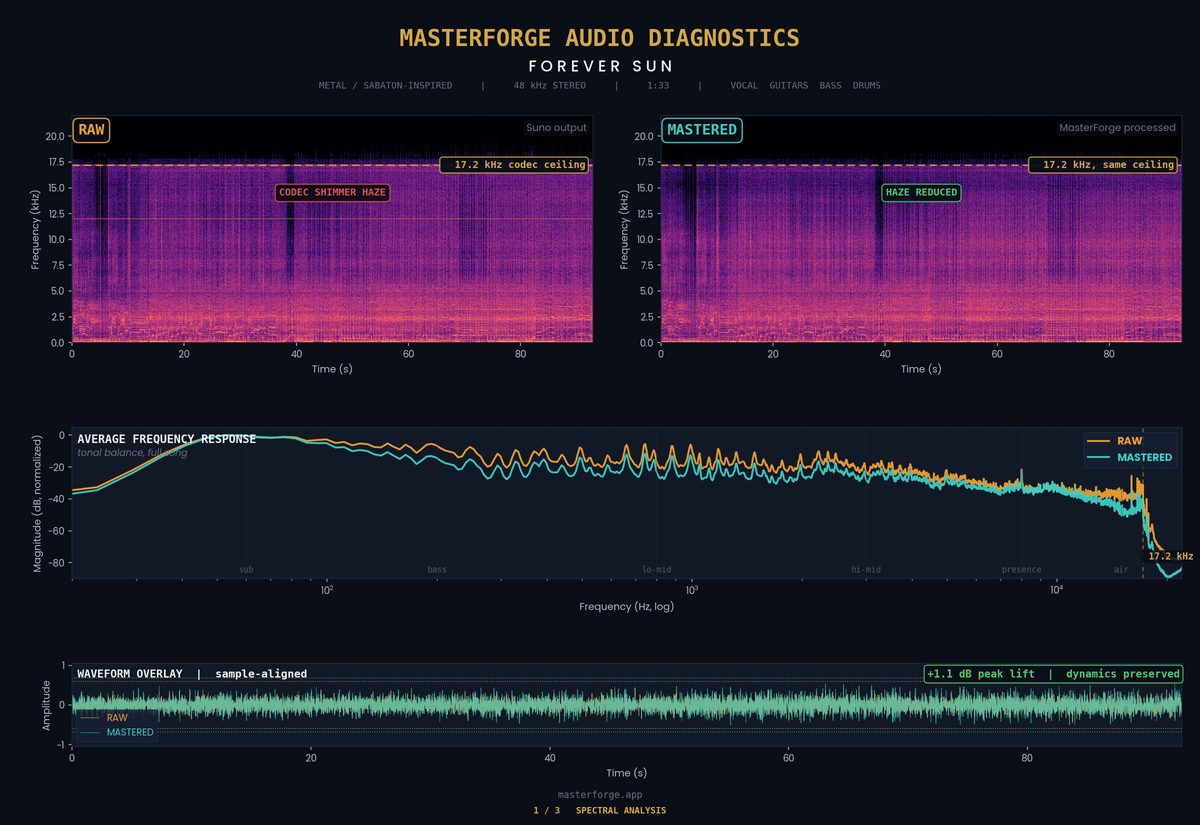
A Sabaton-style metal bed, BW 17.6 kHz. Correlation 0.76 on the raw and phase risk 5.8% are excellent for the genre. The side was strong in the sub band (+17.0 dB) and especially in air (+29.1 dB), the largest air-side in the set.
What mastering did
Peak +0.9 dB, Crest -0.07 dB. Minimal tightening. Side cleanup was much more moderate than on Endless Darkness: Sub +6.2 dB instead of +15.8 dB. That difference is the master responding directly to source quality. Phase was already nearly fine, so the master didn't have to make a heroic intervention. Correlation 0.76 to 0.96.
Try this
Metal Wall or Strong & Punchy. Forever Sun handles either.Metal Wall plus AI Artifact Suppressor at 50%, Shimmer 12 dB. Side EQ Lo (200 Hz) at -2 dB. Pro Master's value here is precision: you decide how much side cleanup is right, instead of letting automation decide for you.A Note on Metal and Codec Shimmer
If you listened to the metal cards (10 through 13), you heard something that side cleanup alone can't fully solve. Codec shimmer.
Shimmer is a metallic, glassy texture in the high frequencies. It's the codec's best guess at detail it couldn't fully encode. On a piano-and-voice ballad like Slow Bloom, shimmer is barely present because there's space in the spectrum. On a five-piece metal track at 200 BPM, shimmer is everywhere because the codec ran out of bits to allocate.
Pro Master's AI Artifact Suppressor reduces shimmer with controls for Shimmer Threshold, Fog Reduction, and Pitch Sensitivity. It works, but it has a floor. The four metal masters in this article demonstrate both the improvement and the limit. That's an honest description of where the tool stops today.
SpectralForge is currently in beta. It works on the spectral domain before mastering, using HPS decomposition and Wiener filtering to separate musical content from artifact noise at the source. That's something a normal mastering chain, or any black-box service, can't do. When SpectralForge ships, the four metal cards above will get an additional recommendation. For now, AI Artifact Suppressor in Pro Master is the strongest tool available for this problem.
What This Tells Us
Thirteen tracks. Thirteen masters. The patterns:
Side cleanup works on all of them. Always in the same direction. Strength varies dramatically, from +1.6 dB on Circus to +14.5 dB on Bright Side, but the move is the same: pull artifacts out of the side channel. If you do nothing else to a Suno track before publishing, do this.
Bass mono is rarely useless. Twelve of the thirteen tracks benefited from collapsing low frequencies to mono below some crossover frequency. Sub leak from the side channel into the stereo field is one of Suno's signature problems, and one of the easiest to fix.
The right amount of every other treatment depends on the song. Loudness moves ranged from -3.1 dB (Bassure, intentionally lowering peak for SPL headroom) to +2.6 dB (Slow Bloom, opening up sparse dynamics). Crest factor ranged from -5.3 dB (Bassure) to +1.9 dB (Endless Darkness). LRA ranged from -1.3 dB (Letkuttele, tightening the reggae pocket) to +1.2 dB (Underwater, opening up the witch house drift). There's no master setting that's right for everything, because there's no song that's like everything.
Codec shimmer has a ceiling. Pro Master's AI Artifact Suppressor is the strongest tool available right now for this problem, and it works, but it has limits on dense material like metal. SpectralForge will address what's left when it's ready.
Side cleanup, bass mono, and song-aware treatment. Those three principles cover almost everything you saw in this article.
Most online mastering services skip the first two entirely. They don't decompose mid and side. They don't measure phase risk or correlation. They apply a loudness curve and a limiter to whatever you upload. For traditional recordings that were already mixed by a human, that can be enough. For AI-generated audio, where the artifacts live in the side channel and the bass bleeds into the stereo field by design, it isn't.
Every track in this set needed a different recipe. That's not a limitation of mastering. That's the definition of mastering done right.
Read Next: Why Arrangement Matters
Look back at the cards, and watch what happened in the sub band as the arrangement got denser.
Slow Bloom is a 3/4 ballad with three instruments. Voice, piano, light drums. Sub side cleanup needed +10.2 dB. That was enough.
Endless Darkness is a Sabaton-style metal track with a full band, harmonies, and orchestration. Sub side cleanup needed +15.8 dB. The codec ceiling on the raw was at 16.6 kHz versus Slow Bloom's 11.2 kHz, but the phase risk was 54.8% versus Slow Bloom's 41.6%. More instruments, more side garbage, harder cleanup.
This pattern is across the whole set. The sparser the arrangement, the smaller the side cleanup needed. The denser the arrangement, the more aggressive the master had to be, and the closer it got to the limits of what mastering can do at all.
Mastering is a finishing step. It can fix a lot, but it can't restore detail that the codec discarded during generation. And the codec discards more detail when you ask it to encode more sound.
That's the argument behind the next article. Why Arrangement Matters takes this idea and tests it directly: same prompt, same model, different instrument counts, measured outcomes. The hypothesis is that piano-and-voice will outperform a five-piece band on the same generation engine, every time, on every metric we measured here. The data in this article suggests it's likely. The next one proves it.
If your goal is professional-sounding AI music, the playbook starts before the master button. It starts with the prompt that decides how many instruments compete for codec budget.
We'll see you there.
Hear the Difference on Your Own Track
Step 1: See what's hiding in your audio. Upload any Suno track to MasterForge Audio Analyzer for a free AI Audio Health score, Streaming Readiness score, and full artifact breakdown: shimmer, fog, bass coherence, phase risk, dynamic quality, and noise floor. No account needed.
Step 2: Fix what you find. Pro Master is the engine behind every master in this article. Six-band M/S EQ, AI Artifact Suppressor, real-time monitoring, and the per-track control that generic services can't offer. Your track, your recipe.